
The Role of the Guru: A Living Current of Grace
For thousands of years, seekers in many spiritual traditions have turned toward the figure of the guru—not as a personality, but as a principle. One of the most exquisite scriptural expressions of this principle is the Guru Gita, the “Song of the Guru.” Scholars debate when it was written: some place it in the 17th century, while others claim it existed long before.
But regardless of the date, it is the resonance of the chant that is so significant. When we listen to it in the depth of our heart, the Guru Gita serves as an invitation to experience the liberating Grace that flows to us through the guru, the teacher, the lineage, and ultimately, from Consciousness Itself.
The Guru Principle and the Means of Awakening
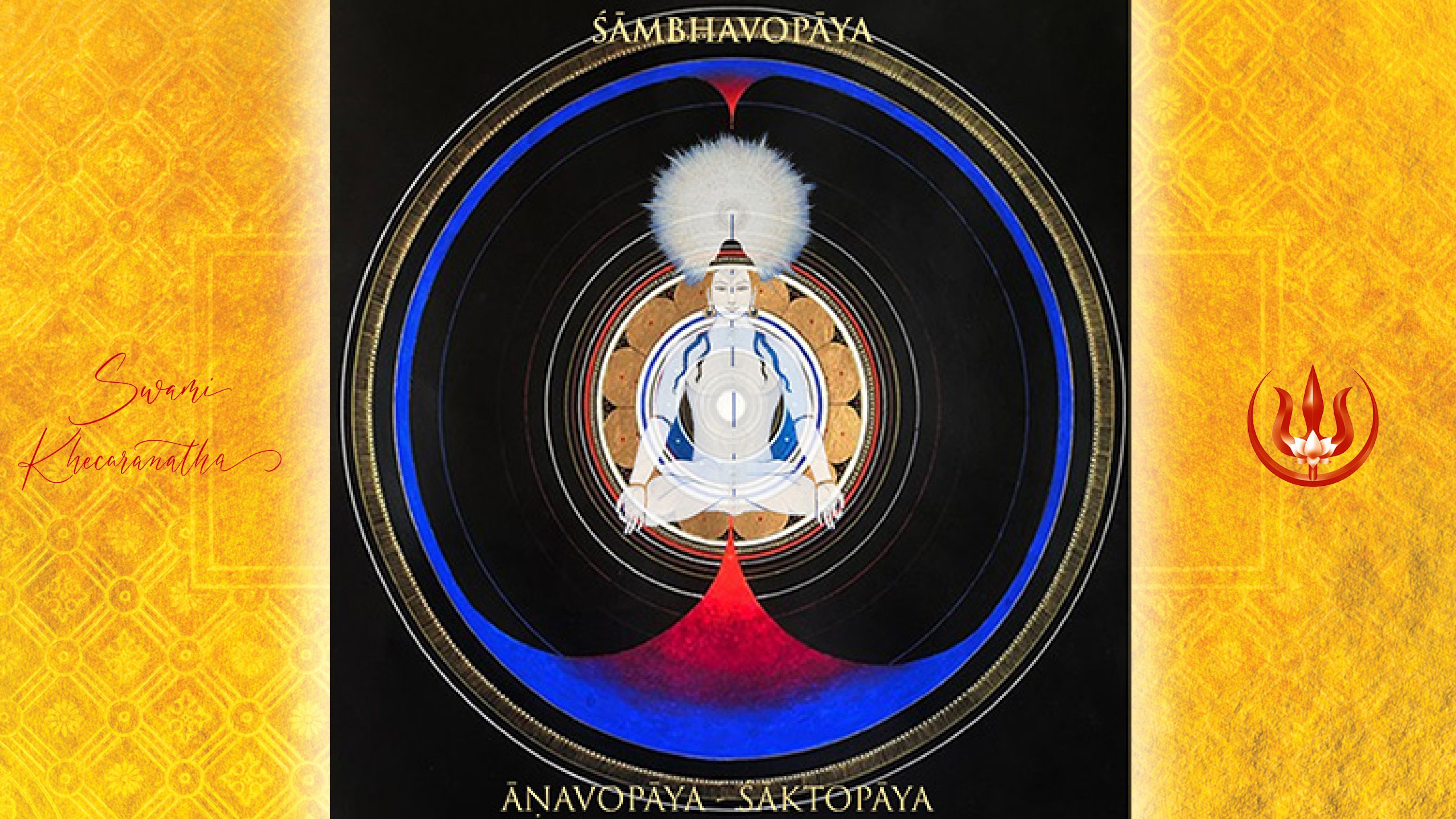
The image above beautifully illustrates what is known in the nondual Tantric tradition as the Guru Tattva. In the Shiva Sutras, one of the most important texts of the Śaiva nondual teachings, the process of awakening is described through three means, or upāyas: Śāmbhavopāya (the path of Divine Will or Pure Awareness), Śāktopāya (the path of energy), and Ānavopāya (the path of individual effort).
The image’s descending red arrow symbolizes Grace (as Śāmbhavopāya) reaching into the individual’s limited perception, initiating the upward movement toward freedom. Yet it’s important to understand that all the means of realization originate not in human striving but in the One Guru, the divine source of Consciousness.
Through the guru principle we recognize that the Divine, like a compassionate and persistent caller, reaches out to us again and again, pointing us toward the central truth that we are not separate or different from our Source. God calls. God whispers. God roars. And yet, often we do not hear.
Because of this deafness—or rather, this forgetfulness—the Divine manifests a means by which we can hear: the guru.
The Three Dimensions of the Guru
Traditionally, guru is understood to have three dimensions, all of which coexist. Each of these forms serves a purpose, allowing us to hear the call of the Divine more clearly:
- The Embodied Guru, Āchārya, or Teacher
This is the teacher in human form—a person who shows up in your life, challenges you, comforts you, reflects truth back to you, and, when needed, pulls you across thresholds you would never cross alone. This embodied presence is not divine because of personality but because lineage, Grace, and awakened Consciousness flow through that individual. - Guru Bhāva
Bhāva means resonance or vibration, which is carried in a lineage. It is the subtle field that radiates through and around the human teacher. This resonance does not diminish when a teacher is no longer embodied, and, in many cases, it becomes stronger. Grace, once awakened, does not die with the form through which it flowed. - The Guru as God
Ultimately, there is only one Guru: Consciousness Itself. As a 12th-century text beautifully puts it, this Guru is “the unbroken transmission of the rays of awakened Consciousness that comes to us through lineage.”
Grace Begins the Journey
The Shiva Sutras opens with one of the most profound statements found in any spiritual tradition: Consciousness is the Self. The Self is consciousness.
If we truly heard this—fully, viscerally—our spiritual practice would be complete. No teacher would be necessary. But the sutras continue with a second declaration: The Guru is the means.
To realize the truth that Consciousness is both our essence and our nature, we require guidance. Not because we are weak or unworthy, but because our perception is distorted by habit, fear, and the smallness of our egoic self-image. All three levels of Guru act as a tuning fork, bringing our own consciousness into alignment with its innate, highest nature.
When Grace descends, longing awakens within us. This is not the longing that stems from lack, but a yearning for recognition. This is the Divine within wishing to know Itself more fully. And that longing attracts exactly the energy, teaching, and lineage we need to uncover the full realization of what is always present, always within us. This is the mysterious, magnetic power of the guru principle.
Walking the Path of Freedom
The journey through the upāyas is not linear; it is a dance between effort, energy, and surrender. In the beginning we rely on effort. We do the practices given to us with discipline and begin to understand the value of selfless service. As our inner energy awakens, we move into the path of energy, allowing the divine force of Śakti to shape our lives. Finally, there comes a maturing into pure awareness, in which Grace Itself reveals freedom and we are able to simply abide in consciousness.
But no matter where you find yourself on this continuum, do not lose sight of the miracle: something in you has begun to respond. Something in you is listening. Something in you recognizes truth when it appears.
In an age of digital connection and virtual practice, it is tempting to bypass the embodied teacher. But the physical presence of a living teacher provides a doorway, a bridge between one’s longing and the Divine’s call. The teacher is someone who helps us break out of our constrained, limited awareness, into the knowledge of the Self, often by providing individual guidance as well as the energy we need to support us in our growth. To reject the embodied guru is often to reject the very Grace you desire.
Your Life as the Field of Awakening
The deepest teaching of the guru principle is simple: the Divine is revealing Itself in your life. Right now. Through your challenges, your practices, your relationships, your mistakes, your longing.
So ask yourself: Do I live in the downpour of joy that consciousness naturally radiates?
If not, the invitation is clear: do your sādhana, recommit, surrender more deeply, and draw upon the lineage that supports your awakening.
Every day, cultivate the audacity to demand your own freedom. This longing, awakened by Grace, is the electricity that powers the entire path. Use it well. Do not get distracted by life’s countless detours. You were given this life for a single, extraordinary purpose: to walk into the heart of God.
And the guru—whatever form it takes in your life—is simply the means by which that journey becomes possible.