
The Lineage of My Teachers
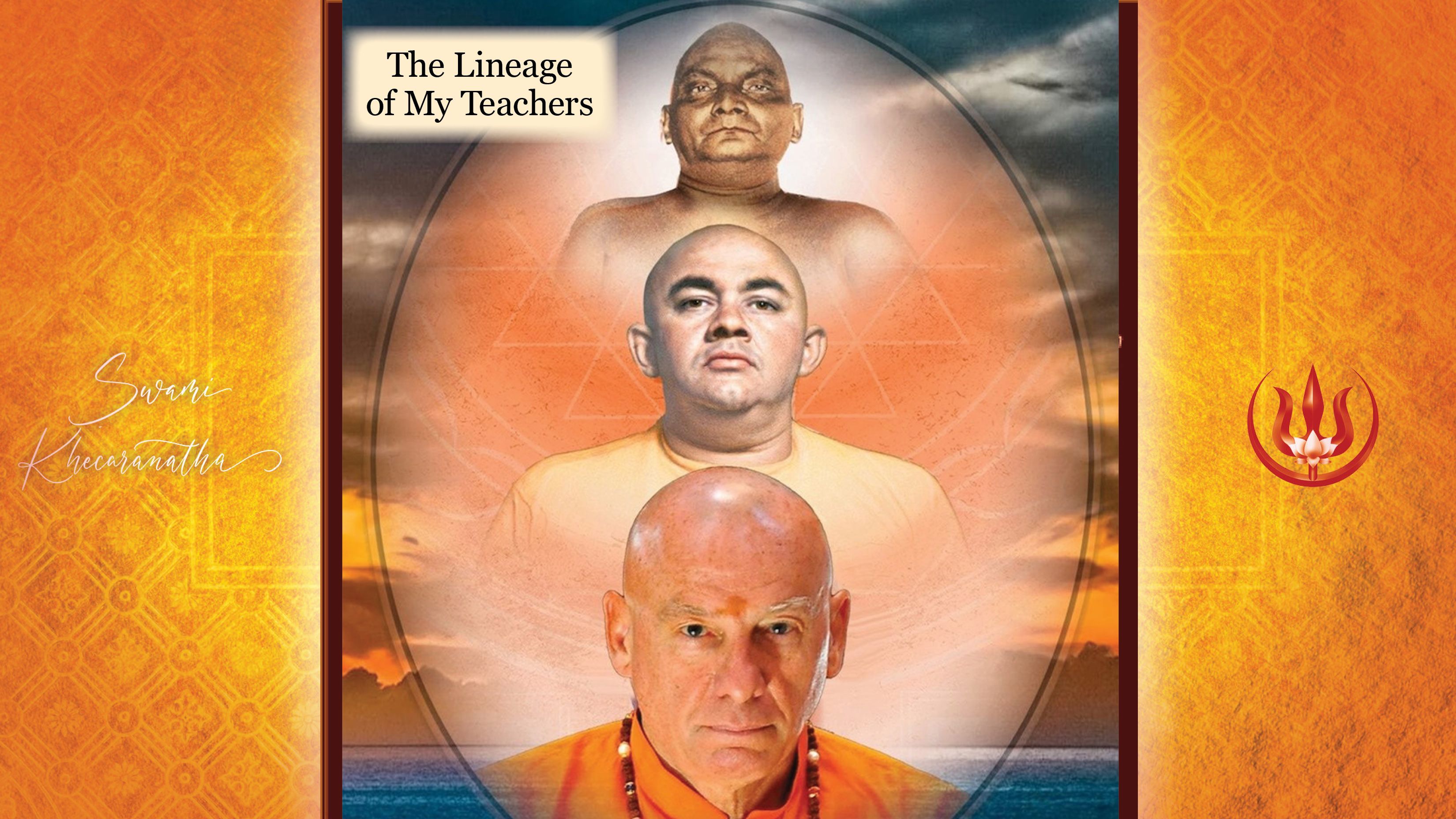
A lineage is an unbroken transmission of a living spiritual force that is passed from heart to heart. It flows from one generation to the next—from a teacher to the student he wishes to initiate as a lineage carrier. Although this force manifests within a teacher, this living energy is greater than that which is carried within any person. A lineage carrier serves that force.
As a lineage carrier in this tradition, I feel a deep gratitude to every teacher who has gone before me. They have passed down an enormous wealth of knowledge and have provided the practical tools to enable generations of seekers to gain their liberation. I am honored to do my small part in perpetuating this vital teaching given to me by my teachers.
Swami Rudrananda: His Practice & Teachings
I was blessed to have Rudi as my teacher. He called his practice “the work,” and developed a powerful set of techniques, including a unique “open-eye class” for śaki transmission, an integral part of Kuṇḍalinī Sādhana. Although he did not study scripture, Rudi’s practice and teachings were a perfect expression of the most sacred of the Tantric Śaivite practices of ancient times.
Rudi was a complex man, but he lived in profound inner simplicity. He was extraordinarily powerful, yet gentle and full of Grace and love. Rudi was unconditionally focused on the dissolution of any limitation within himself as the means to allow God to emerge and reveal Himself. Having been aware of his spiritual potential as a very young boy, he spoke of continual inspirational visions and experiences that guided him on his path.
If I had to describe Rudi’s spiritual teaching, I would say there are three elements central to his practice:
- opening the heart and cultivating a deep wish to grow
- working internally to establish a flow of energy through the psychic system
- living in a state of surrender
These three elements function as one dynamic. Rudi taught that they must be brought into our practice and into our lives every day. The discipline he required of himself and his students was the foundation of his teachings.
Rudi said that attaining liberation in this lifetime was our right, and that freedom was available to anyone who wanted it. He emphasized that cultivating the wish to grow would transform our experience and consciousness if we worked with depth over time. That depth is accomplished through opening our hearts, feeling the flow of spiritual energy within and with all of life, and surrendering to God.
Rudi’s Last Words
In February of 1973, Swami Rudrananda departed from this world in a small plane crash in the Catskills. Remarkably, the other three passengers walked away with only minor injuries. Rudi’s last words, dictated on the plane moments before it crashed, perfectly express the essence of his life and his teaching:
The last year of my life has prepared me for the deeper understanding that Divine Consciousness can come only through unconditional surrender. That state is reached by surrendering ourselves and the tensions that bind and restrict us, keeping us from expressing the power of creation that is our true essence. It is God flowing through us and showing us that we are nothing but Him. I want to live as an expression of that higher creative will, and from a deeper sense of surrender.
While Rudi had several teachers, it was his relationship with Bhagavan Nityananda that catapulted his growth into its most profound dimensions. Rudi said, “My first meeting with the renowned Indian guru, Bhagavan Nityananda, was of such a depth that it changed the course of my life.”
Although Rudi may only have met Nityananda once or twice in person, it was the relationship that developed after the saint’s passing that was the most important expression of their connection. Rudi described this profound relationship as existing on a spiritual level that was not limited by the absence of Nityananda’s physical form.
Bhagavan Nityananda
Nityananda, whose name means “bliss of the eternal,” lived in southwestern India from around the turn of the twentieth century until 1961. Details of his early life are difficult to verify, but from the 1920s until his passing, he was surrounded by an ever-increasing number of disciples and devotees. By the late 1930s he was established in Ganeshpuri, a small village in the countryside near Mumbai, and an active ashram developed around him.
In India today, Nityananda continues to be revered as a great saint who lived as the divine expression of stillness, purity, and joy. His teaching was profoundly simple. Like the ancient sages of many traditions, its essence was that liberation occurs within every person when they merge their own individual consciousness into the Divine—and Nityananda clearly emphasized the awakening of the Kuṇḍalinī as the path to liberation.
To realize the universal nature of one’s own awareness, to be absorbed into the heart of God, is the goal of sādhana (spiritual practice). The Nityananda Sutras outline the elements that are the essence of his experience, and therefore of his teaching:
- developing the subtle discrimination of seeing the One in the many
- cultivating detachment
- expressing devotion
- establishing an inner practice
- living in profound simplicity
- discovering unconditional joy
- living in Grace and in communion with the Divine
Nityananda often sat in a room in the ashram that was lit only by a few bare electric light bulbs, resting there quietly, with his eyes open. People came from considerable distances to see him because in India, the mere viewing (darśana) of a spiritual teacher is considered to be a profound blessing. The powerful forces of śakti that continuously emitted from Nityananda permeated the environment around him.
His presence attracted thousands of people, who wanted to receive his darśana. Each person who came in contact with this saint experienced the miracle of Pure Consciousness in human form. Bhagavan Nityananda was a holy person who was considered an avadhūta. Timeless and eternal, the avadhūta is a direct link to the Absolute, encompassing all the teachers who preceded him and all who follow.
Rudi and Nityananda’s Presence is very much alive today and accessible to anyone who sincerely wishes to reach out to them. I encourage my students to find and connect with the energy and Consciousness of our lineage within their own hearts.