
Pure Motive - Part One
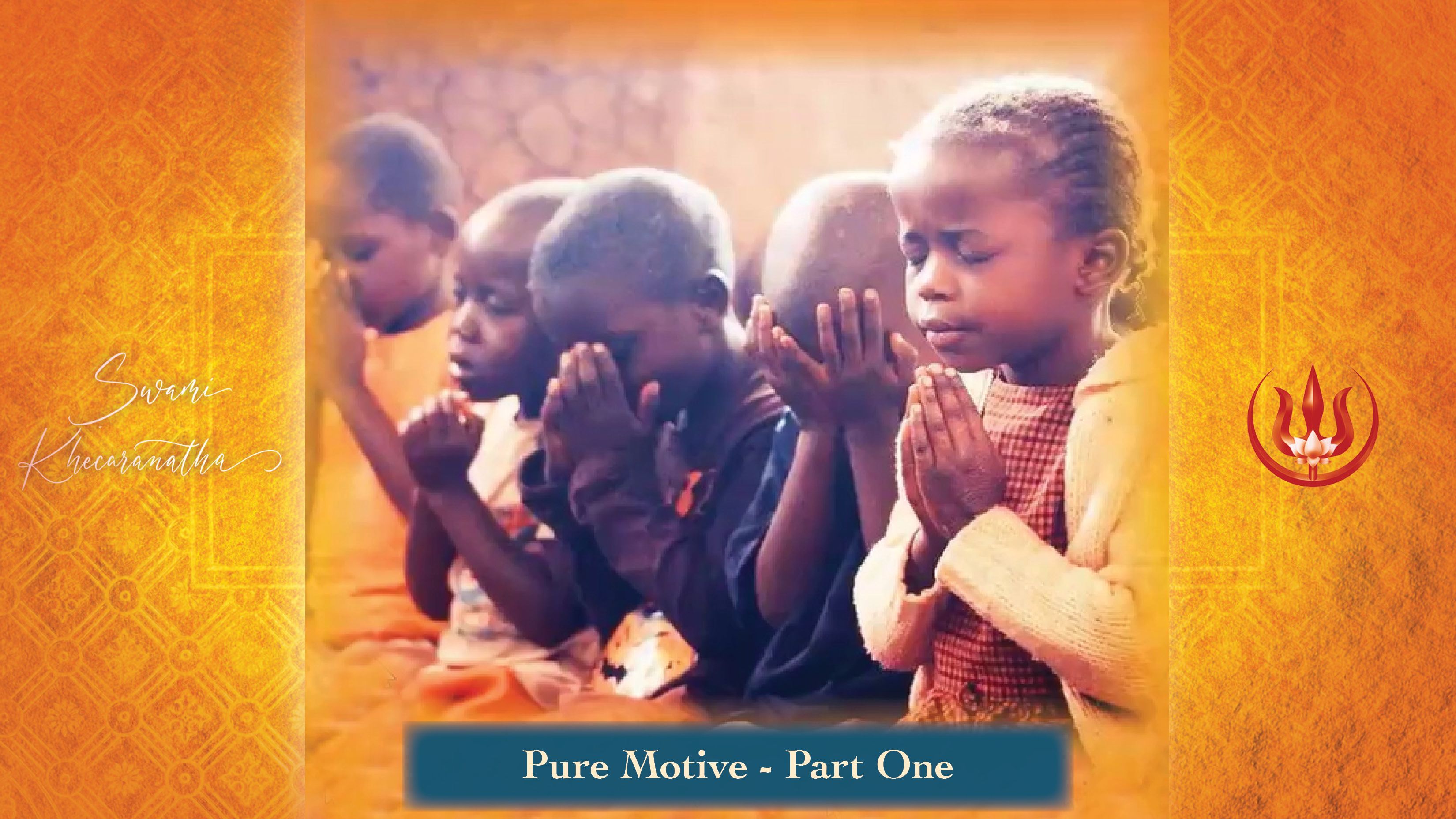
As we consider our path from limited, individual awareness to unbounded awareness, it’s helpful to understand the idea of “pure motive” as a means of awakening to the Divine within us. There is a description of the means of spiritual growth at the heart of the nondual tantric tradition that I find myself returning to, both in teaching and in my own practice. These are called the upāyas, and within them lives a distinction that changes everything: the difference between effective method and pure motive.
Effective method is what we do. Pure motive, śuddhabhāva in Sanskrit, is why we do it. It is the unwavering intent within us to discover the highest in ourselves. And while the methods may shift and evolve throughout our lives, that pure motive is the thread that runs through all of it.
In the Śaiva and Śakta Trika tradition the upāyas are described as four distinct paths. At the highest level is anupāya, the path of no means: the place of spontaneous, absolute revelation where no technique is necessary because the Divine has simply seized you whole. However, it is an extremely rare individual who experiences this level of transformation.
Then there are the means most people use: ānavopāya (the path of individual effort), śāktopāya (the path of energy, insight, and surrender), and śāmbhavopāya (the path of awareness, sometimes called the path of Śiva's will).
What's important to understand is that these aren't rungs on a ladder you climb one by one. They are a nonlinear continuum, all unfolding simultaneously, looping back on themselves. You make an effort. You open your heart. You cultivate the flow of energy within you. That very cultivation becomes the foundation from which a deeper Śakti can move. And accessing deeper Śakti opens you to its source, which is Consciousness Itself.
The determinant of which path is most alive in you at any given moment is Grace, or śaktipāta, the descent of knowing. This is not something you manufacture. But neither are you passive, because once Grace descends, it is the depth and longevity of your response to that opening that determines your spiritual growth.
The Danger of "Nothing to Be Done"
I often encounter the idea that there's nothing to be done. In one sense that's absolutely true, because ultimately it is God doing the work of freeing Himself from the limitations of individual misunderstanding. But unless we are living in that direct recognition that there is no separation between us and the Divine, there is something to be done.
Perhaps it means making the effort to open your heart or cultivating the capacity to stay open even when life pushes back hard. Perhaps it means surrendering our thought-constructs so that deeper knowledge can arise, or releasing our willfulness so that Divine Will can actually move through us.
The trap is in making "nothing to be done" a resting place because it can become a very comfortable way to avoid the difficult terrain of our own consciousness. What the tradition actually points to is a maturation that may feel cyclical: doing our practices as we focus on our divine intent, forgetting, walking back into it, forgetting again, walking back once more. This process does is not indicative of failure, but rather, it is the path as it reveals itself throughout our lives.
Liberated While Alive
One of the central teachings of the Śaiva Śakta tradition is jīvanmukti, or liberation while alive. This means that realization of our union with God doesn’t come after death, but in this body, in this life.
Most traditions have hedged on this. They say that liberation is possible, but probably after you're dead. What good is that? The upāyas exist precisely to address this: how soon in our embodied life does that recognition take place, and what is its nature?
Liberation, in this tradition, is not the dissolution of individuality. It is never, ever, a denial of that. But it is the revelation that your individuality is the joyful expression of Divine Will. The fact that most of us don't experience it that way simply points to the need to transform our awareness through inquiry, meditation, and the dissolution of our limited perception.
Pure Motive as Devotion
Our Satguru Nityananda says: As is your devotion, so is your liberation. He was pointing to exactly this: that suddhabhāva, pure motive, is really the discovery of the Divine wish within us and the aligning of our wish with it. That wish, at its core, is to express joy and freedom.
There are phases of devotion that exactly mirror the upāyas: the act of devotion, the energy of devotion, and the state of devotion. We move through them the same way we move through the means — not in a straight line, but in deepening circles.
After his initial statement, Nityananda adds something nobody wants to hear: Devotion does not eliminate difficulties. It doesn't make life perfect. It doesn't remove the hard work of moving through our own misunderstanding. But the gift is that devotion means we can come face-to-face with our misunderstandings rather than being ruled by them. That's how our limitations are consumed; how a particular dimension of our own consciousness becomes recognized and transcended rather than continuing to restrict our enjoyment of life.
My advice is this: Every morning when you wake up, before you get out of bed, take a breath. Feel the presence of the Śakti that is already moving in you. Then open your eyes and engage your day from that place.
Know that this very intention will reveal any part of you that is not open. Whatever is binding you will surface in your awareness so that you can see it and then do the work to remove that obstacle. This is how the liberated state becomes real. Not as a concept. Not as a distant promise. But as the lived, embodied recognition and expression of pure freedom.
Respond with pure motive to that Divine invitation, to the Grace that is saying, Come on home: We’ll leave the light on.